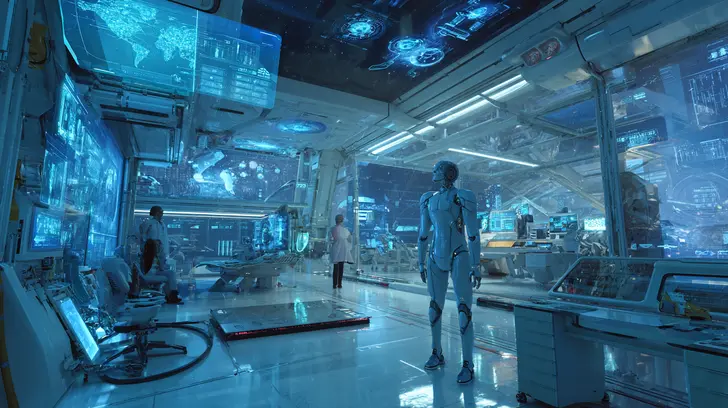
Introduction 🚀
In recent years, the integration of Artificial Intelligence (AI) 🤖 and Virtual Reality (VR) 🕶️ has sparked a
technological revolution that is reshaping the way we interact with the digital world. This combination, often
referred to as the "AI & VR Revolution," represents a significant leap forward in the evolution of immersive
experiences, smarter environments, and the development of innovative industries.
As these two powerful technologies converge 🔗, they unlock new possibilities across entertainment 🎮, education 📚,
healthcare 🏥, business 💼, and beyond. Unlike previous waves of technological change, the AI & VR Revolution is not
just about convenience — it is about creating whole new worlds of experience. This blog explores the impact,
potential, and challenges of this ongoing revolution and provides a comprehensive overview of how these technologies
are set to redefine our collective future 🔮.
The Rise of AI & VR 📈
Artificial Intelligence: The Brain Behind the Digital Age 🧠
Artificial Intelligence is the simulation of human intelligence by machines. AI systems can learn, reason, and
solve problems, making them invaluable in automating processes ⚙️ and generating insights 💡 from vast amounts of
data. From voice assistants like Siri 🎙️ and Alexa to predictive analytics in business and personalized
recommendations in entertainment, AI is already a central part of our daily lives .
Beyond consumer products, AI powers critical systems such as fraud detection in banking 💳, predictive maintenance
in industries 🏭, and real-time language translation 🌐. These applications highlight AI’s ability to process
information faster than humans and to adapt continually as new data emerges.
Virtual Reality: The Gateway to Immersion 🌌
Virtual Reality, on the other hand, is a technology that creates simulated environments, allowing users to
experience and interact with digital worlds as if they were real. Through VR headsets 🎧 and sensory equipment 🎛️,
users can explore virtual landscapes, play games 🎲, collaborate with teams 👥, or even receive medical training
🩺 in a safe, controlled setting.
Unlike traditional media, VR fully engages the senses, producing a sense of presence — the feeling that you are
truly “there” in a virtual environment. This immersive quality makes VR suitable not only for entertainment but also
for therapy, design, and education.
The Convergence: AI & VR Revolution 🔗
The AI & VR Revolution represents the convergence of these two transformative technologies, leading to experiences
that are not only immersive but also intelligent. AI enhances VR by making virtual environments more responsive,
adaptive, and personalized. For instance, AI algorithms can adjust the difficulty of a VR game in real time or
modify a virtual training session based on user performance.
Together, AI and VR are rapidly changing the landscape of digital interaction 🌍. The convergence points toward a
future where digital systems do not just replicate reality but expand it, creating intelligent immersive spaces that
continuously evolve with us.
Applications of the AI & VR Revolution 🌟
1. Entertainment and Gaming 🎮
The entertainment industry is at the forefront of the AI & VR Revolution. Video games now feature intelligent NPCs
(non-player characters) powered by AI, creating more dynamic and unpredictable gameplay. VR transports players into
fully immersive worlds, where AI algorithms generate realistic physics, adaptive difficulty levels, and personalized
storylines.
For example, AI-driven VR experiences can analyze a player's choices and emotions to modify the narrative in real
time. This leads to unique, replayable gaming experiences tailored to individual preferences, making entertainment
more engaging than ever. Future innovations may allow players to co-create storylines alongside AI companions that
learn and adapt like real friends.
2. Education and Training 📚
AI & VR have revolutionized education by creating interactive learning environments. Students can participate in
virtual classrooms, conduct scientific experiments in simulated labs 🧪, or travel through history in immersive
timelines ⏳. AI personalizes learning paths, assesses student progress, and adapts content to suit individual needs.
In professional training, VR simulations powered by AI provide realistic scenarios for medical, aviation, and
military training. Trainees can practice complex procedures, make decisions under pressure, and receive immediate
feedback, all within a risk-free virtual environment. This reduces errors, enhances confidence, and accelerates
mastery.
3. Healthcare 🏥
The AI & VR Revolution is making significant strides in healthcare. VR therapies are used to treat phobias, PTSD,
and chronic pain by immersing patients in controlled environments. AI analyzes patient responses and adjusts the
therapy accordingly, enhancing effectiveness.
Surgeons use VR simulations to plan and practice complex operations 🧑⚕️, while AI assists in interpreting medical
images, predicting outcomes, and suggesting treatment options. In rehabilitation, VR environments gamify exercises,
while AI tracks progress and adjusts therapy. This combination reduces errors and improves patient care
significantly.
4. Business and Collaboration 💼
Remote work and collaboration have been transformed by AI & VR. Virtual offices and meeting spaces allow teams to
interact as if they were physically present, breaking down geographical barriers. AI-powered assistants schedule
meetings, analyze communication patterns, and facilitate workflow management.
Businesses use VR for product prototyping, customer engagement, and employee training, while AI provides data-driven
insights to optimize operations. The result is increased productivity, creativity, and global connectivity 🌐. In
the near future, fully AI-driven VR workspaces could become the standard for distributed organizations.
5. Retail and E-Commerce 🛍️
Retailers are harnessing the power of the AI & VR Revolution to enhance customer experiences. VR enables customers
to virtually try on clothes, explore stores 🏬, or visualize products in their homes 🏡. AI personalizes
recommendations, manages inventory, and predicts trends.
This creates a seamless shopping journey, reduces returns, and increases customer satisfaction. The fusion of AI and
VR is setting new standards for convenience and engagement in retail, paving the way for “intelligent stores” that
anticipate customer needs before they even arise.
The Technology Behind the AI & VR Revolution 🔬
Machine Learning and Deep Learning 🤖
AI systems rely on machine learning and deep learning algorithms to process data and learn from experiences. These
technologies allow AI to recognize patterns, predict outcomes, and make decisions without explicit programming. In
VR, AI analyzes user behavior and adapts environments in real time.
Natural Language Processing 🗣️
Natural Language Processing (NLP) enables AI to understand and respond to human language. In VR applications, NLP
allows users to interact with virtual characters, control environments with voice commands, and receive personalized
feedback, making experiences more intuitive and accessible.
Computer Vision 👁️
Computer vision allows AI to interpret visual information, track user movements, and recognize objects within VR
environments. This technology is essential for gesture-based interaction, facial recognition, and realistic avatar
animations.
Neural Networks in VR 🧠
Neural networks are used to create lifelike simulations, realistic physics, and intelligent behaviors in VR. They
enable virtual characters to learn from user interactions and adapt their responses, resulting in more believable
and engaging experiences.
Challenges of the AI & VR Revolution ⚠️
Technical Limitations 💻
Despite rapid progress, the AI & VR Revolution faces technical challenges such as hardware limitations, high
processing requirements, and bandwidth constraints. Developing seamless, high-fidelity experiences requires
significant computational power and advanced graphics technologies.
Privacy and Security 🔒
The integration of AI and VR raises concerns about data privacy and security. VR systems collect extensive data on
user movements, preferences, and biometric information. Ensuring the protection of this sensitive data is paramount
to maintaining user trust.
Ethical Considerations ⚖️
AI-driven virtual environments can blur the lines between reality and simulation. This raises ethical questions
regarding addiction, manipulation, and mental health. Developers must consider the impact of immersive experiences
and implement safeguards to promote responsible use.
Accessibility ♿
Ensuring that AI & VR technologies are accessible to all users, regardless of physical ability or socioeconomic
status, remains a challenge. Developers need to prioritize inclusive design and affordability to prevent the
creation of digital divides.
The Future of the AI & VR Revolution 🔮
Smart Cities and Environments 🏙️
The AI & VR Revolution is set to play a crucial role in the development of smart cities and environments. AI will
manage urban infrastructure, optimize energy consumption, and enhance public safety. VR will enable citizens to
interact with digital twins of their cities, participate in planning processes, and access services in immersive
formats.
Personalized Experiences 🎯
AI will continue to drive personalization in VR, creating experiences tailored to individual needs, preferences, and
emotions. From custom entertainment to adaptive learning and healthcare, the future will be defined by smarter, more
responsive environments.
The Metaverse 🌌
The concept of the metaverse — a collective virtual shared space — is gaining momentum thanks to the AI & VR
Revolution. AI will manage complex virtual economies, social interactions, and content moderation, while VR provides
the immersive platform for creativity, collaboration, and exploration.
Industry 4.0 🏭
Manufacturing and logistics are embracing the AI & VR Revolution through smart factories, predictive maintenance,
and immersive training. AI analyzes production data and optimizes workflows, while VR allows workers to visualize
processes and collaborate remotely.
How Businesses Can Prepare for the AI & VR Revolution 🏢
Invest in Talent and Training 👩💻
To leverage the benefits of the AI & VR Revolution, organizations must invest in skilled professionals and training
programs. Developing expertise in machine learning, VR development, and data analytics is essential for staying
competitive.
Foster Innovation 💡
Businesses should encourage experimentation and innovation, exploring new applications for AI & VR technologies.
Collaborating with startups, research institutions, and technology partners can accelerate development and adoption.
Prioritize User Experience 🎨
Successful AI & VR solutions must prioritize user experience, focusing on intuitive interfaces, accessibility, and
personalization. Collecting feedback and iterating on design ensures that products meet the needs of diverse users.
Ensure Security and Ethics 🔐
Implementing robust security measures and ethical guidelines is critical for responsible deployment of AI & VR
technologies. Businesses should be transparent about data usage, prioritize privacy, and promote digital well-being.
Conclusion ✅
The AI & VR Revolution is transforming the way we live, work, and play, ushering in a new era of intelligent,
immersive experiences. By harnessing the power of Artificial Intelligence and Virtual Reality, we can create smarter
environments, personalized interactions, and innovative solutions to complex challenges. As technology continues to
advance, the possibilities are limitless — provided we address the technical, ethical, and social issues that arise
along the way.
Whether in entertainment, education, healthcare, business, or beyond, the AI & VR Revolution is set to redefine our
digital future. Now is the time for individuals, organizations, and societies to embrace these technologies, invest
in talent, and shape a future that is both intelligent and immersive.
Contact Me
Want to learn more about AI & VR or build your own immersive project? Check out Offer or Contact Me for a free consultation!