Introduction 🚀
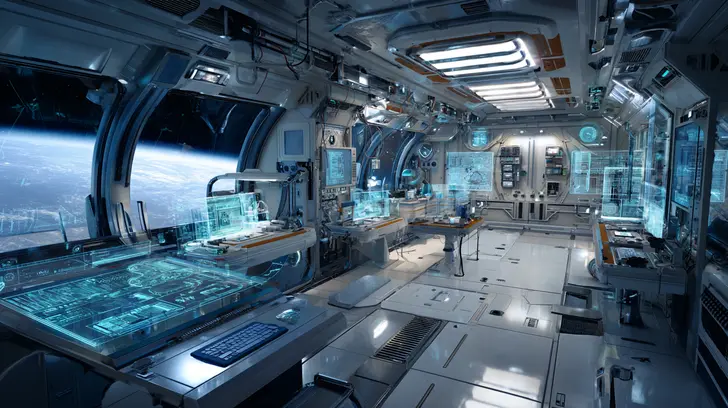
Orbiting hundreds of kilometers above the Earth's surface, space stations have always been at the forefront of
technological innovation. Today, they are rapidly evolving into intelligent habitats, where artificial intelligence
(AI) 🤖, robotics, and advanced algorithms are reshaping every aspect of life and research in space.
As humanity prepares for deeper exploration of the cosmos , the fusion of AI with space station operations is
unlocking new frontiers in science, safety 🛡️, and sustainability . This blog explores how AI is
revolutionizing space stations—from the International Space Station (ISS) to upcoming private and national
platforms—and what this means for the future of living and working in orbit.
The Evolution of Space Stations 🛰️
From Manual Operations to Automated Intelligence 🤖
Early space stations like Salyut and Mir relied heavily on human expertise and manual control. Astronauts managed
life support, communications 📡, experiments 🔬, and maintenance 🛠️. However, as missions grew longer and more
complex, the need for automation became clear. Today’s space stations incorporate increasingly sophisticated
technology, with AI standing at the center of this transformation.
The International Space Station: A Platform for AI Innovation 🌐
The ISS, a collaboration between NASA, Roscosmos, ESA, JAXA, and CSA, is a testing ground for advanced AI systems.
From robotic assistants 🤖 to environmental monitoring 🌡️, AI helps astronauts conduct research, optimize
resources, and maintain safety. The ISS demonstrates how intelligent systems can support human crews in the harsh
environment of space.
AI in Space Stations: Applications and Impact 🌟
1. Robotic Assistants and Crew Support 👨🚀
AI-powered robots, like CIMON (Crew Interactive MObile companioN) and NASA's Robonaut, are already assisting
astronauts aboard the ISS. These robots can answer questions, fetch tools 🛠️, monitor crew health , and even
provide emotional support during long missions. Their ability to understand natural language 🗣️, process complex
instructions, and interact intuitively makes them invaluable partners in orbit.
2. Autonomous Environmental Monitoring 🌡️
AI systems continuously monitor atmospheric composition, temperature, humidity, and radiation levels inside space
stations. By analyzing data streams in real time, AI can detect anomalies, predict equipment failures ⚠️, and
recommend corrective actions—often before humans are even aware of a problem. This proactive approach is essential
for maintaining crew safety and optimizing resource use.
3. Scientific Research Automation 🔬
Space stations are hubs of cutting-edge research, from biology 🧬 to material science. AI automates complex
experiments, controls laboratory equipment, analyzes results, and adjusts conditions to maximize data quality.
Machine learning algorithms process vast amounts of information, identifying patterns and insights that would be
impossible for humans alone.
4. Maintenance and Repairs 🤖
Maintaining a space station is a constant challenge. AI-driven systems schedule routine checks, diagnose faults, and
even command robotic arms or drones to perform repairs. These systems reduce the burden on astronauts, decrease
downtime, and help extend the lifespan of critical hardware.
5. Communication and Coordination 📡
AI enhances communication between space stations, ground control, and other spacecraft 🚀. Intelligent systems
manage data traffic, translate languages 🌐, and optimize bandwidth. They also coordinate complex operations, such
as docking maneuvers and supply deliveries, ensuring everything runs smoothly in the dynamic environment of orbit.
6. Psychological Wellbeing and Social Interaction 💖🧘♂️
Long-duration missions in space can be isolating. AI companions provide conversation, entertainment 🎮, and mental
health support, helping astronauts cope with stress and loneliness. By recognizing emotional cues and adapting their
responses, these systems foster a healthier and more resilient crew.
Technologies Powering AI on Space Stations 🤖
Machine Learning and Deep Learning 📊
Space station AI relies on machine learning and deep learning algorithms to interpret sensor data, recognize
patterns, and make decisions. These technologies enable predictive maintenance, autonomous navigation 🧭, and
adaptive environmental control.
Computer Vision 👁️
Cameras and sensors throughout space stations feed data to AI systems, which use computer vision to detect hazards
⚠️, monitor crew activity, and inspect equipment. This capability is critical for remote monitoring and robotic
interventions.
Natural Language Processing (NLP) 🗣️
NLP allows astronauts to interact with AI systems using spoken or written language. This makes robotic assistants
more accessible and user-friendly, enabling more natural and efficient collaboration between humans and machines.
Edge Computing and Cloud Integration ☁️
Space stations often operate with limited bandwidth and must process data locally (edge computing). AI systems are
optimized to run autonomously in orbit, with cloud integration for tasks requiring more computational power or
coordination with Earth-based teams.
The Future: Intelligent Habitats Beyond Earth
Private Space Stations and Commercial Platforms
Companies like Axiom Space, Blue Origin, and Sierra Space are developing private space stations that will rely
heavily on AI for automation, safety 🛡️, and research. These platforms aim to make space more accessible to
scientists, tourists , and industry partners, ushering in an era of intelligent orbiting habitats.
Lunar and Martian Bases 🌕
As humanity prepares to establish outposts on the Moon and Mars, AI will be essential for autonomous operations,
environmental control 🌡️, and crew support 👨. Intelligent systems will manage life support, resource
utilization, and communication across vast distances, enabling sustainable exploration and settlement.
Interplanetary Collaboration
AI will facilitate coordination between multiple space stations, planetary bases, and spacecraft. Autonomous agents
will share data, optimize logistics, and respond rapidly to emergencies ⚠️, creating a resilient and
interconnected human presence in the solar system.
Challenges and Considerations
Technical Limitations
Running AI systems in space presents unique challenges: limited computational resources, harsh radiation ☢️, and the
need for robust cybersecurity 🔒. Engineers must design hardware and software that can operate reliably in extreme
conditions and recover from failures autonomously.
Ethical and Social Implications 🤔
As AI becomes more integral to space operations, questions of autonomy, trust, and decision-making arise. How much
control should AI have? How do we ensure transparency, accountability, and fairness ⚖️ in critical systems? Human
oversight and ethical frameworks will be essential for safe and responsible integration of AI in orbit.
International Collaboration 🤝
Space stations are inherently collaborative projects. Integrating AI across international partners requires common
standards, data sharing agreements, and joint research efforts. Working together will maximize the benefits of
intelligent systems for all humanity.
Conclusion 🌌
The age of intelligent space stations has arrived 🚀. By harnessing the power of AI, robotics 🦾, and advanced
algorithms, humanity is creating safer, more efficient, and more productive habitats in orbit.
As we look ahead to lunar bases , Martian outposts , and commercial platforms 💼, the fusion of artificial
intelligence with space exploration will be key to unlocking the next chapter in our journey beyond Earth. The dawn
of intelligent orbit is not just a technological revolution—it is a testament to human ingenuity, collaboration 🤝,
and our endless quest to explore the unknown.
Contact Me 📩
Want to learn more about space technology or build your own AI/space project? Check out Offer or Contact me for a free consultation!